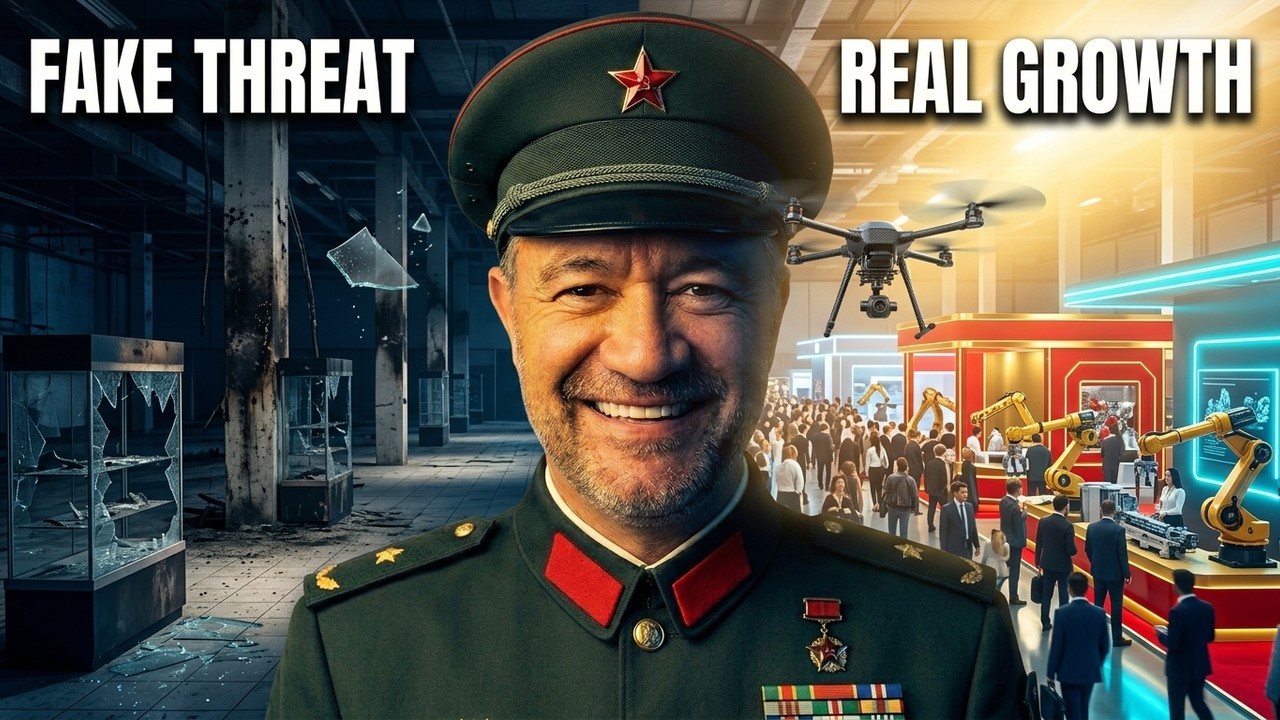
China Fear Factory Debunked Real Geopolitics

Jul 26, 2026

View on YouTube

Chapters

00:00 Foreign Affairs Hates China Again 01:15 The China Threat Narrative 02:45 China's Real Global Economic Power 04:30 China's Role in Global Growth 06:10 The Factory of the World 07:35 China's Military Evolution 10:05 Western Military Decline 12:15 The Drone vs Missile Problem 14:00 China's Agile Military 15:30 Pragmatic Geopolitics 17:00 Trade as a Lever 19:00 The Future of Global Relations

Transcript

This endless China thread, I mean, let's talk about this right, because this is getting pushed constantly by foreign affairs, they like to push this story, they like to freak us all out, you know, with the old China thing, the China thread narrative, not just foreign affairs, but like, you get a lot of these stories and it's all like, just crazy stuff, so I wanted to shine a light on this, so come with me, it'll be interesting, interesting chat. So yeah, a recent foreign affairs piece follows a familiar script, where China is being portrayed yet again as a destructive force, are relentlessly pursuing its goals at the expense of everything that you hold dear, that I hold dear, that everyone in the West holds dear, not a one off, not a one off at all, this is part of a series of similar arguments that dominate much of the magazine's China coverage foreign affairs, it's a magazine, it's about geopolit, it's really good, it's got a, I wouldn't say it's a magazine of record, but it is a notable publication relating to geopolitics, so the tone is always like, oh my god, you know, it's alarmous, every single time they do this, it's framing China's rise as an existential threat, rather than just a look at the complex mix of competition, cooperation and mutual benefit, that's literally all this is, but they want to make it much, much more, they want to freak everybody out, I guess it's clickbait, but it is quite serious to what they're doing, so critics, they rightly point out that this approach ignores the broader picture of China's role in the global economy, they're a massive player in my humble opinion team, that's the biggest player, by far, by far, far more realistic measure and comparison comp between economies is PPP, GDP, and by far, right, by far, China, China wins, wouldn't that rate, so it's obvious, yeah, so they have massive contribution to global growth, and we're going to talk about that now, so China accounts for roughly one third of global economic growth in at least in recent years, and this is not abstract, right, this is real jobs, real investment and development across the world, a lot of loans have been written, a lot of infrastructure has been built, new markets have been opened up, a lot of trade, they're buying a lot of energy, they're buying a lot of food, they're buying a lot, they're buying a lot of stuff, because it's got a massive population, so 1.4 billion people, so massive, you know, mainland sort of population, and that means they are, while they're a massive player, particularly in emerging markets and commodity producing countries, watch that, put a pin in there, if you produce commodities, then they want to deal with you, they want to trade with you, they want to buy stuff, want to sell your stuff, mercantilism, China's scale, right, they're manufactured, they are the factory of the world, indisputable, absolutely, they're investment in infrastructure, they're demand for war materials, have literally, it's lifted hundreds of millions of people out of poverty in China, at the same time, it's supporting growth in countries all around the world, because they sell stuff and they get money and return, they trade, and if they can't trade with somebody else, but they can trade with China, why not? That's a good thing, and it enables countries to grow, so I've also talked before on this channel about like, do I believe that China will be a benevolent dictator in 50 years, maybe his little is 30 years? Yeah, because I think my argument is I've already won the GDP, PPPP race, and there's nothing that can pull that back, it's done, it's gone, but so if you assume that's true, and if you assume that you have a military decline in the West, there's lots of discussion around that, I've had lots of that discussion, basically saying our system is designed around like a four million dollar pack free surface to wear, missile to shoot down a two thousand dollar drone, and we have to fire two of those pack three, so it's eight million a shop, and we often miss, so we're doomed, we're going to look at our current, our military is doomed, our military I'm saying the Western military, so collectively all Western countries, you know, we all invest in this military, you know, industrial complex, I'm ex-Air Force, I worked on a strike squadron, maybe on its engineer for some wonderful years, when I was a wee pup, best time ever, amazing, so I kind of have a good idea of how that system works, better than most at least, and I might take away as, look out, back in the 80s and the 90s, we were formidable, we had systems that nobody could only dream of having these systems, you know, a sidewinder, either we're missiles, the aim, the aim missiles, the harms, the alphas, you know, you're going to hang a couple of alphas underneath the drone, fly that drone to the other side of the world, and then use a camera to pick up your target and then deliver that bloody hellfire, you know, air to ground missile with a massive payload on the front of it, because boom, you could do that from the other side of the world, and they would regularly go and do that, it's just, you know, it was a miracle, really, what was invented and delivered back over the, you know, right up through a barmer's time, but after that, things change, the whole Ukraine thing, this whole Ukraine debacle, and really switch things up, and Iran has proved the point, you can't win these conventional, old-fashioned wars with, you know, with these systems that we, that I grew up, I can't not take all these systems, and I, you know, they were at the time, they were leading systems, they dominated the world, you hop into the cockpit of an F-16 or F-35, and it's like, Jesus Christ, it's unbelievable, it's like, it's like something out of Star Trek, or it's something out of, you know, Star Wars, it's just awesome, I mean, it is awesome, the helmet alone is, the helmet's like, what the hell, you know, it is pretty impressive technology, but it's irrelevant, it's been made irrelevant by these latest two conflicts, so, do I think we're, you know, we're going through this transition right now, at the moment, do we have the capability to react and respond in an agile manner to all these new systems? No, that is 100% clear, otherwise, we wouldn't have had the debacle in Iran and the debacle in Ukraine, they would be done, but we do, so, yeah, I think the sun is set on that, and I don't, I think that the West has an opportunity to pivot, but the issue was the 2000 versus 8 million, and the military industrial complex is used to charging 8 million for a system that only works like 10% of the time, 8 million per shot against the $2 million drone, a $2,000 drone, it's just stupid, but the military industrial complex, they use it, that's their system, they've designed it for years, they've got like patents, and they've got a lot of, you know, engineers and scientists that have invested in this existing system, so can we switch to a new system where we're talking about much lower cost units? I don't know, I'm not sure, I think I don't know if we can, we're used to having, you know, Top Gun, we're used to having Top Gun, you know, like I died, we've got a major, a major leap to make before we can pivot to this new system, so I think China are much more agile and nimble, if you've seen some of the drone swarms, they do, it's like, and the robots they've got, I mean, across, come on man, Team West, either, should'll get off the park basically, don't sit on the park, and thrush your chest out and think that you can take these people on, because you are losing, you are losing badly, so don't do it, just don't do it, it's not with it, like the whole thing in a round right now, it's like just cool to win, cool to the day, don't go and talk about something else, because yeah, there'd be dragons down there, there'd be a lot of dragons, I'm not just me saying that, there's a lot of very accomplished US war veterans that have got decades of experience on strike squadrons in the US military, and these guys are no joke, they know everything about everything, they do everything about their existing systems, right up to the latest spec, and they are saying, Jesus, we've got to get out of this, it's really bad, and we do, we need to get out of it, so, but yeah, China, they're formidable, we went off there, a little bit of a distraction, but well worth it to make this point, that China is a formidable competitor that requires a very smart pushback, it's not a cartoon villain, it's not that, not at all, and it's not bent on destroying the West yet, and my argument before around, are they benevolent dictator, well, I don't think they are, are they a good dictator, will they be a good leader of the world? I don't think they are, and I don't think they want to be, I don't think they want to be like the US where they were the policeman of the world, I don't think that's, tell me if I'm wrong, who knows, right, who knows, if you've been to China before, and you've got some Chinese friends, and you kind of have had some insight into how the Chinese think, I spent 20 years going in and out of China and Asia, and so I've got a reasonable, maybe better than some people, but I'm no expert, so love to know what you think, but my perspective is they will not be a kind dictator, they will not be a benevolent good actor when you're talking about their region, if you're messing about in their region, I think they're going to be quite brutal, I think there's, I think all the century of humiliation, I'll talk about it in a separate video, but there's I think all the century of humiliation which has not been forgotten, it's not been forgotten, it has not been forgotten, it's like carried on through the generations, so I think messing about in their region, they will be a regional hegemon, which means they're going to be like, America, USA, is the regional hegemon for the continent from Alaska, down through Canada, through the USA, Mexico, South America, all the way down to Argentina, that entire landmass, that is their patch, they call it the Monro Doctrine, and it was agreed with Europe basically, they basically, the Americans back in the day, in the 1800s, they said to Europe, you lot piss off, don't come here, this is our patch, if you come in here, we're going to get to stay out of our patch, you know, you do your thing, we'll do our thing, that's end of it, so I think that's changing, I think that's changing, yeah, but I and Greenlands over here, so Greenlands close enough, they're going to take Greenlands, so yeah, so the point is America is a, it is the regional hegemon, there is only one, and it's America, and I think that's going to change, so I think if you have ambitions as a country to go messing about in China's patch, we don't know what China's patch includes, it obviously doesn't include Russia, we don't know what it includes, they'll leave it there, how far down to the Pacific it goes, well I don't know, but it is a regional hegemon, and I don't think it's going to be a very nice player if you're in that region, I think it's going to be pretty tough, it's going to be extremely tough, so that's why I think it's useful to know about, you know, to have some context about China, because I think generally trade with China, trade as much as possible again, because trade protects you, because, you know, it's a good quote, right, if you've got a large trade arrangement with them, then they've got a large trade arrangement with you, then you've both got a balance of power, I don't think you want a one-sided arrangement, I don't think you just want to export to them and that's it, that's probably quite dangerous, but if you've got some balance in that relationship, then trade becomes the lever, not war, you know, you'll always use trade first, just like what happened with China and the USA, where USA came out and did all that crazy stuff, and they were like, oh, we're going to whack all these sanctions on you, and then which was like an economic war, they said, we're going to sanction you, you're going to have to pay this money, we're going to charge all this stuff, because we don't like you, and then China was like, fine, no problems, okay, we understand, but we're going to do the same to you, so we're going to put tariffs on you, and we'll sanction these things, and we're going to put an export ban on rare earths, and all these other stuff to you that you really need, and you're going to come crying, and they did, and they could pitch you later, and they would draw all the sanctions, so you can see that trade is a much safer way of actually settling conflicts between countries, and especially if you're a smaller country and you're trying to deal with a regional hegemon, you really want to have layers upon layers upon layers of a highly valuable trade engagement, so that you've actually got something that they really want, and then they've got something that you really want, and you're probably more likely to settle things through a trade dispute rather than something else, something very bad, so this, to me, is the smarter part of pragmatism, there's something I, on YouTube, I just like to be extremely pragmatic when it comes to geopolitics, not ideological, for me it's all about realism, pragmatism, how can you be pragmatic, but also be realist, a realist at the same time, how can you compete vigorously and cooperate where possible, and focus relentlessly on strengthening your own innovation, your own industrial strength, and making sure that you trade like mad, you trade like mad, that's the one thing that we should we collectively, and the West should be doing, we should be trading like we've never traded before, that there is the way to a safe and secure world, so yeah, I mean I say I feel, I really do feel it's the world is safer, if you've got a lot more at stake between your country's trade and an adversary, I think there's a lot more, like if Russia had a lot more trade with the USA, they wouldn't have got into this strife, there's no way, or I mean look what happened to Europe, Europe basically had to cut off their energy supply, which is damaging their economy, and now that I'm trying to run one that as fast as they can, there's six countries who have basically capitulated and said to Brussels, we want carve outs from these then extensions package, so you can see how deep trade links between countries, this is the way to a safe and secure world in my humble opinion team, so yeah, that's how I feel, tell me how you feel, if you disagree, it's okay, yeah, just tell me, stick it in the comments down below, please be kind, but I'm up for that, so yeah, and please, 85% of people who watch this little YouTube show, it's tiny, 85% aren't subscribed, so if you're one of the 85% do me a big solid, go and go down below, click the subscribe button, a little bell icon to be notified about new episodes when they drop, I'd be much appreciated, but we're a UR team, I hope you have a great day, cheers, bye.