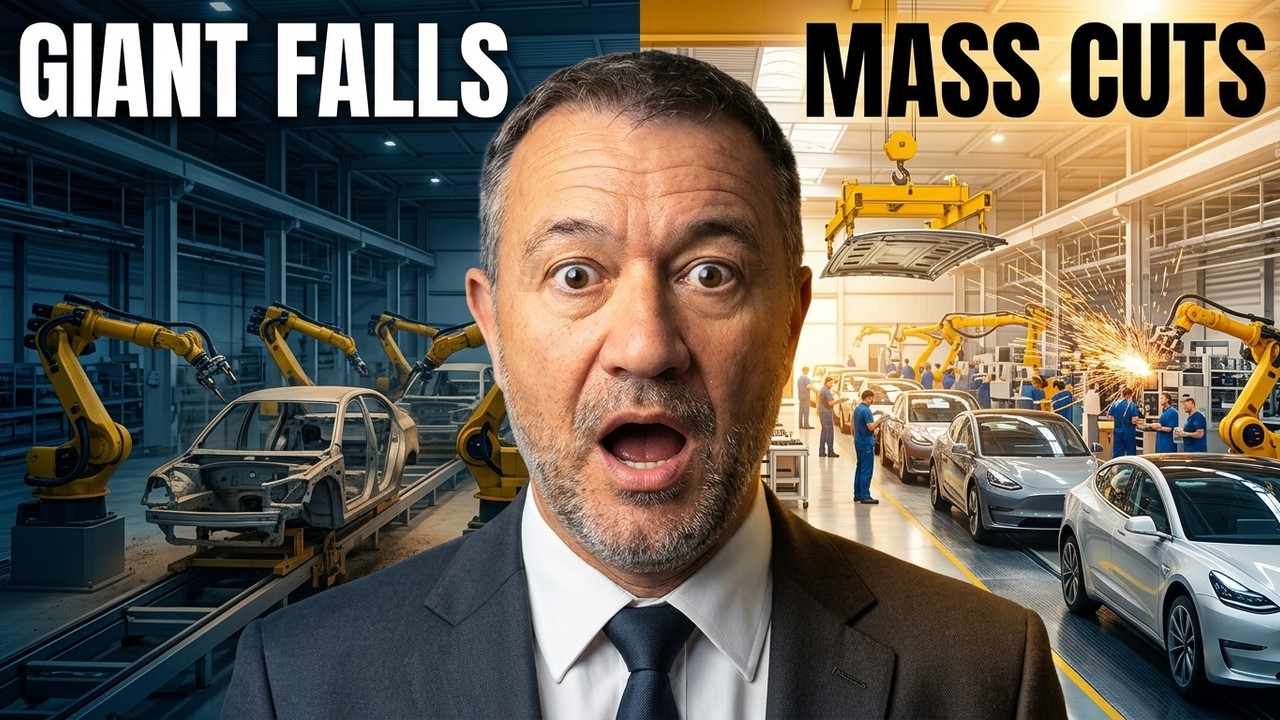
VW 100,000 Job Cuts German Industry Collapse

Jul 18, 2026

View on YouTube

📺 Full episodes → longwave.media/@dave

Chapters

00:00 Introduction: VW's Shocking Job Cuts 01:14 The Scale of the Crisis: 100,000 Jobs at Risk 02:28 Chinese Competitors: BYD's Impact 04:02 Historical Context: Job Losses Since 2020 05:12 Economic Impact: GDP and Supply Chain Devastation 07:45 The Wider Supply Chain Collapse 10:12 The Failure to Pivot to EVs 12:30 Ideology vs. Pragmatism: Tesla's Rise 14:15 A Spectactular Failure of Adaptation 15:35 The Pain of Write-Downs and Potential Bankruptcies 17:04 The Fate of European Brands 18:15 Conclusion and Penguin Spotting

Transcript

Oh my God, I can't believe it. Volkswagens 100,000 job cuts, the collapse of German industry. Let's just get, goes from bad to worse for Germany, the shocking announcement. The Volkswagen is planning to cut up to 100,000 jobs and ends production at four major German plants, including a handover, as we call it, I'd say that, Emden and Audi's facility near Neckar Sum, Neckar Hume, I don't know what that was either. This would be the largest restructuring in the company's 89 year history and one of the biggest in European automotive history. I see all of a bloom is pushing the plan as necessary for survival against Chinese competitors, unions and the state of lower Saxony are resisting, they're good luck unions. But the scale of the crisis is now impossible to ignore team. 100,000 job losses, Christ. Now, that's just V-Dub, right? That is only V-Dub. I mean, it's a big bloody industry. So just V-Dub, that's roughly 15% of the group's global workforce, cutting four more plants would immediately put more than 45,000 direct jobs at risk. These cuts come on top of tens of thousands of jobs. Job losses already made across the German auto sector in recent years. Now, this team is not normal. There's not normal restructuring, that is not normal. This is an major acceleration and a major retreat of the industry. Now, let's have a look at the job losses. Let's put this into context. We'll look at the job losses since 2020. Six years and then we'll go out projections to 20, 34 years. So the German auto industry has already lost over 51,000 jobs in the past 12 months alone. Wow, it's really been cranking there. Since 2020, the sector has shared tens of thousands. This is like, I was in Maliga recently and I was standing on top of the hill, looking out the port. And the new V-Y-D boat had just pulled in and there were, I don't know, it looked like 10,000 V-Y-D cars on the wall and they were driving them off the thing. And they were just, because about three, four, five months ago on the bus stops around Malia, they had a V-Y-D car for 12,000 euros brand new. And people were just like, what? That normally you used to buying a car for a small car, 22,000, 25,000 euros. And all of a sudden you had this Chinese electric car or hybrid, even better, they love hybrid, but they had all electric as well. The 12 grand was like, what? So people were just, this is lining up, buying, getting really old piece of junk, your old petrol car and getting one of these fancy new things from China. And that's basically, you know, it's what happened. And do you know the old car that they flocked off? That was a V-Dub. There was like a golf or an Audi or a French, some French thing. For I loved it, I was having France. It's probably much like what's happened here in Germany. But basically, you've now, you've got this situation where it's really getting quite bad. Job losses since 2020, 51,500 in the past 12 months alone. That's really crazy, man. So older government backstudies from 2020 warmed that up to 250,000 to 400,000 automotive-related jobs could disappear by 2030 in a worst-case scenario. Now, V-Dub's new plans suggest the upper end of those forecasts is now becoming reality faster than expected by 2030. The German car industry could be a shadow of its former self if the current trends continue. So the impact on German GDP, the automotive industry directly and indirectly accounts for around 5% of GDP. So it's bloody not small. The big thing supports millions of jobs across the economy. A loss of 100,000 high wage manufacturing jobs at V-Dub. Triggers are massive contraction and economic output. You include the wider supply chain. The total GDP hit easily, 10, easily 30 billion euros. And you'll want the cuts taken into full effect. I mean, so on the face of it, it's like 100,000 jobs lost. You think, oh, shit, that's a lot. But when you look at it that way, that's 30 billion a year. There's just been, there's vanished out of the economy. These are big numbers, man. These are big numbers. Germany's export model, already under pressure, is suffering, major blow. And it's just devastating. Not just a company problem. This is a national economic crisis and they're making the real damage, though, team. And this is kind of hidden. This, it goes far beyond just the V-Dub factory gates because a Volkswagen car, an Audi car, the, I mean, there's so many manufacturing brands actually inside the V-A-G family. But these cars, there are so many cars actually use the, you know, you pull the thing out, like a Bugatti, you pull the airbag out of a Bugatti and it comes out of a, like a, just a V-Dub sedan, you know. So a lot of cars in the industry, they use components from, from the V-A-G. And that's why you end up with devastation right across the supply chain. So for chemicals, it's a good example. So companies like BASF, they lose, there's major customers for plastics. You know, if you think about the dash, the seats, the trim, you know, the inside of the boot, the tires basically, it's just kind of a form of plastic, really. Companies like BASF, they make this stuff. The battery materials, they build all of this stuff, you know, the aluminum, the lead, all the components, all of the components are made from these raw materials. And that sort of stuff comes from companies like BASF, a major, I think it's one of the biggest companies in Germany. Metals, producers, supplying steel and aluminum for body panels and components and castings, they obviously see demand collapse. And then they actually collapse demand on other companies. So like they buy robotics from other German companies, they buy massive casting faces from other companies, they get maintenance contracts with other companies, they've got all this. It all goes downstream from there as well, I'm saying. Glass manufacturers, another one. So they supply windscreens and all glass of the car too. They just lose, they just lose major business, engine and transmission suppliers. So already struggling, of course, with the sectoral shift to EVs, they just see entire production lines just come, they totally redundant. Completely and utterly redundant. There's no demand for a diesel or a petrol car nowadays, those engines and transmissions are gone. It's not just the engine, but it's also the transmission is not cheap. When you buy a car, you don't think about it, but the transmission is quite a big expense out of the percentage of total. So we don't use those in an electric car. They just have the motor, it's just a cheap electric motor. So yeah, you don't need an expensive transmission. So that's kind of, you know, in behind the scenes is a lot of destruction of industry in Germany, not just Germany. It's right across the Europe actually. Bottom line, V-Dub, I plan to cut another, I'm right, it's another 100,000 jobs and close four German plants. Now that's not just corporate restructuring, it's a visible collapse of Germany's industrial model. After years of self-inflicted energy policy damage and the failure to pivot to EVs. And so they've just let the Chinese come in and eat their lunch. So yeah, Germany's watching its economic crown jaw being dismantled in real time. Yeah, and I think a lot of this is around, you know, I like to talk about ideology versus pragmatism. And a lot of this goes back to about 10 years ago when Tesla were launching their Model 3 and the Model Y and the German car magazines and well, the entire sort of industry was laughing and mocking, you know, I don't know if you remember, but back then it was like, oh, here's a Tesla's going to catch on fire. And all these wonderful jokes and, you know, everyone was laughing and mocking Tesla. But yeah, look who's laughing now. They were not able to get over their hubris and to confront what was happening in there in front of them. I mean, they, they, I was reported at the time that they flew over some of the first released Model 3 Model Y's and they had contracts with people that pull these things apart and they inventory the, you know, how the things are built so that they've got all the knowledge, they've got the ability to replicate a Model 3 if they want, but they didn't. Instead, they went for basically an adaptation of their existing factory lines. They decided to try and keep their existing factories and try and integrate them with a new drive train. And they came up with all these clever ideas to essentially preserve their existing, you know, factory model and it was a complete and utter failure. What a failure, spectacular. And they were never able to just accept that. Their, their world as they knew it was dwindling. It was just dying. And now it's kind of, it's well past that, it's well past that. So, terribly sad for that industry in Germany and for the people that are involved because they're on the losing side, you know, sadly. So, very difficult for, for those folk. If you're one of those folk, I'm really sorry. It's just terrible, but Pivot, man, Pivot, absolutely as fast as possible. Get off that bandwagon, get on to this new evolution and ride it as fast as you possibly can. Yeah, yeah, terrible situation for Germany. But let me tell you, it's only just started. This is just the start of a, it'll be years and years of stories like this. I'm just gonna do this one, I'm not gonna carry on because it's bloody miserable, really. But I could tell you, it's just the start of this. And I don't see like, for example, the V-Dub in order for them to pivot, they would need to write down all of the intellectual property that they have in, they're existing vehicles like an airbag or not so much an airbag because you have airbags in an EVs. But let's just say a turbo or an engine management module or the software stack for transmission, I don't know, all that sort of stuff, all that intellectual property that I've got, all of the patents and royalties that I've arrived, that's all gone. A lot of it is gone, a lot of that is just gone. It's just absolutely gone. We're talking, I'm guessing it's, I last time I looked at this was a few years ago, it was $60 billion, it was a $60 billion right down if they did it then, I don't know what it is now, it's probably already written down partially, but that's an example of how much pain they've got to go through. I wouldn't be surprised if they end up just going bankrupt. I mean, some of these legacy autos, we might actually hear that they've had to merge brackets bankruptcy to avoid bankruptcy, and the brands no longer exist or they might exist, but like, you know, with some of these brands that have been sold to the Chinese, because the brand itself can't sustain itself, like Volvo, Volvo is now owned by Geely in China, and they make really nice cars, a really, really nice car, the XC40 I think is called Bloody Good Car, made in China, it's just the brand is owned, the truck's still in Europe, but they bought the car brand, and so they make the cars now in China, they sell one back into Europe, and yeah, that could be the fate of European brands, a bloody terrible situation, but you'll go, I'd be able to enjoy this little episode, and yeah, that's sunset, and yeah, let's have a look at the rocks. There's a bunch of blue penguins come up and hang out on these rocks here. I don't think they nest, I think they just come and visit. Cute little guys, I don't see any, I'll tell you if I do. Yeah, here we go. Nice little walk along the beach. All right, team, well, wherever you are in the amazing world of ours, I hope you have a great day, cheers.